
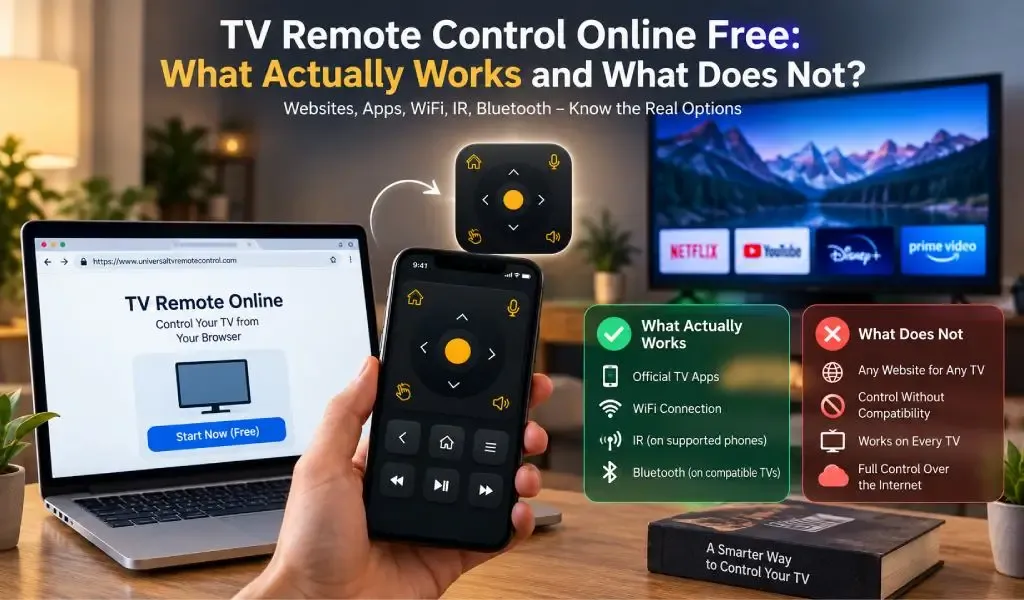
If you search for “TV remote control online free,” you will find websites, remote apps, browser based tools, manufacturer solutions and universal remote services. The problem is that these options do not all do the same thing.
A website can help you find a remote, check compatibility or explain how to control a TV. A dedicated remote app can actually communicate with a compatible television. Some TVs can also be controlled through manufacturer services, while phones with infrared hardware can send commands directly to compatible TVs.
So the important question is not simply whether a TV remote is free or online. The important question is how the phone or computer actually communicates with the TV.
For most modern smart TVs, that connection happens through a local network, Bluetooth, infrared or a manufacturer supported control system. Google, Apple and Samsung all document phone based TV control using dedicated apps or built in mobile features rather than an ordinary website alone.
A free TV remote online usually means finding a remote solution through the web
A free TV remote online usually means that you can find or access a remote control solution through the internet without buying a physical replacement remote.
The word online is where the confusion starts.
Someone searching for a free TV remote might mean:
- A website that provides remote control information
- A browser based TV remote
- A phone app downloaded for free
- A universal remote that works through WiFi
- A remote that works over the internet
- A replacement for a lost physical remote
These are different use cases.
For example, Google lets users control compatible Android TV devices with a virtual remote in the Google TV app. The phone and TV normally need to be connected to the same WiFi network for this type of control.
That means the app may be free to use while the actual remote connection is local rather than internet based.
This distinction is particularly important for anyone searching for terms such as TV remote website, universal remote online, or TV remote control online free.
A normal website usually cannot control any TV directly from a browser
A normal website usually cannot turn itself into a universal TV remote simply because it displays buttons on your screen.
A browser can display a remote interface, but those buttons still need a supported communication path to the television.
Some devices can provide browser based control interfaces, but that is a specific feature of the device or platform. It does not mean that any TV can receive commands from any website.
This is why major TV platforms use dedicated control systems. Google uses the Google TV app for compatible Android TV and Google TV devices. Apple provides the Apple TV Remote through supported Apple devices, while Samsung provides mobile TV control through SmartThings.
So if a website claims to offer a free online TV remote, check what it actually provides.
A useful website should explain:
- Which TVs are supported
- Whether an app is required
- How the TV connects to the phone
- Whether WiFi, Bluetooth or infrared is involved
- What features are available
- Where the official app can be obtained
This is also why your Universal TV Remote Control website and the app serve different but connected purposes.
A TV remote app usually works through a supported local connection
A TV remote app usually communicates with a smart TV through a supported local network connection, although some TVs and phones use other technologies.
For WiFi based control, the phone and TV generally need to be able to communicate on the same local network.
Google explicitly instructs users to connect their phone and compatible Android TV to the same WiFi network when setting up its virtual remote. Apple gives a similar requirement for the Apple TV Remote, while Samsung documents the same network requirement when adding compatible TVs to SmartThings.
The basic process looks like this:
Phone connects to the network
↓
TV connects to the network
↓
Remote app discovers or pairs with the TV
↓
The app sends supported commands
↓
The TV responds
The internet may be involved in downloading the app, updating it or providing other services, but that does not mean every remote command has to travel through the internet.
This is an important distinction between internet access and local device communication.
If you want to understand this difference in more detail, see What Is mDNS and Why Does It Matter for Smart TV Remote Apps?.
A free online TV remote can use WiFi, Bluetooth or infrared
A free TV remote can use different communication technologies depending on the phone and television.
WiFi control works through the local network
WiFi based remote control allows a compatible phone and television to communicate over the same network.
This is particularly useful for smart TVs because modern phones already include WiFi and many smart TVs are designed to connect to home networks.
The limitation is that compatibility matters. The TV must expose a control mechanism that the remote app can use, and the network must allow the devices to communicate.
This is also why having internet access does not automatically guarantee that a remote app can find the TV.
A TV might successfully stream Netflix while the phone cannot discover it because the devices are separated by network configuration.
Bluetooth control works through a nearby wireless connection
Bluetooth can provide another way for supported devices to communicate without relying on the same WiFi path.
However, Bluetooth support does not mean that every TV exposes every remote function through Bluetooth.
The exact capabilities depend on the television, operating system and implementation. Samsung, for example, documents Bluetooth Low Energy support for certain TV discovery and setup scenarios.
Bluetooth is therefore useful in compatible setups, but it should not be treated as a universal solution for every smart TV.
Infrared control works directly between compatible hardware
Infrared control works differently because the command travels directly from an infrared transmitter to the television.
This is essentially the same basic communication method used by many traditional remote controls.
The problem for smartphone users is hardware.
Most modern phones do not include an infrared transmitter. If the phone lacks the required IR hardware, an infrared remote app cannot create the necessary signal through software alone.
That makes WiFi based control more relevant for many modern smartphones, while IR remains useful on compatible devices.
A free remote app can be more practical than a browser remote
A dedicated remote app can interact with the mobile operating system and the TV in ways that an ordinary webpage cannot necessarily reproduce.
A remote app can be designed for:
- TV discovery
- Device pairing
- Local network communication
- Remote commands
- D Pad navigation
- Keyboard input
- Voice control
- Device specific controls
Google's virtual remote, for example, supports navigation, media playback, volume control and text entry on compatible devices.
Samsung's SmartThings remote similarly provides functions such as volume, channels, Home, Back, Guide and navigation on supported TVs.
That makes a dedicated app much more than a webpage containing virtual buttons.
The app is specifically built around the communication requirements of the device.
A free TV remote does not necessarily mean control over the internet
A free TV remote does not necessarily control your television remotely from another location through the internet.
This is one of the most important distinctions to understand.
Imagine your phone and TV are connected to the same home WiFi.
Your phone might use the internet to open a website, but the remote app can communicate with the TV locally.
The path can look like this:
Phone → Home WiFi → Router → TV
That is different from:
Phone → Internet → Remote service → Home network → TV
The second arrangement requires additional infrastructure and is not how every TV remote app works.
Some manufacturer platforms can provide remote control over the internet. Samsung, for example, documents remote TV control through SmartThings for supported setups, including situations where the phone and TV are not in the same room, subject to its account, internet and compatibility requirements.
Therefore, the word online should never be treated as proof that a remote can control your TV from anywhere.
A website is useful because it helps you find the right remote
A TV remote website remains valuable even when the actual control happens through an app.
The website is often where users begin their search.
Someone might start with:
TV remote control online free
Then ask:
Does my TV support phone control?
Then:
Which app should I use?
Then:
Does my phone need WiFi or infrared?
A good website should answer those questions before the user downloads anything.
That is where a dedicated product website can provide value through:
- Brand compatibility information
- Feature explanations
- Setup instructions
- Connection requirements
- Troubleshooting information
- Official download links
- Customer support
Your existing Universal TV Remote Control Website vs Remote App guide explains this distinction in more detail.
A universal remote app can be more useful when you have different TV brands
A universal remote app becomes particularly useful when your home does not use televisions from just one manufacturer.
You might have one Samsung TV, an LG TV in another room and a different brand in a bedroom.
Manufacturer specific remote apps can work well within their own ecosystems, but they are naturally focused on particular brands.
Universal TV Remote Control takes a broader approach.
The app supports more than 700 TV brands, is available in more than 100 countries, and has surpassed 130 million downloads.
That broad compatibility is more meaningful than simply claiming that an app is universal.
It means the application is designed around a large range of television brands rather than one manufacturer's ecosystem.
The exact controls can still vary according to the TV model and supported communication method. A universal app should therefore be judged by its compatibility range and available functionality rather than the assumption that every TV exposes identical controls.
A universal remote app can provide more than basic power and volume controls
A modern TV remote app can combine traditional remote controls with smartphone features.
Universal TV Remote Control includes:
D Pad navigation for moving through menus
Voice control for supported voice based interaction
Keyboard support for faster text entry
A user friendly interface for everyday navigation
These features matter because smart TVs are no longer limited to changing channels and adjusting volume.
People search streaming libraries, enter account information, navigate applications and interact with increasingly complex TV interfaces.
Typing a long search query with a traditional directional remote can be tedious. A phone keyboard provides a much more familiar input method.
Voice control adds another option when supported.
This broader control experience is one reason a dedicated phone remote can be more useful than a simple browser based button panel.
A free TV remote still has limitations you should understand
A free TV remote is not automatically compatible with every television or every phone.
Compatibility can depend on:
- TV brand and model
- TV operating system
- Phone operating system
- Network configuration
- Available permissions
- Supported communication technology
- Whether the TV is already connected to the network
- Whether the phone has infrared hardware when IR control is required
This is why claims such as “works with every TV instantly” should be treated carefully.
For example, Google requires compatible Android TV devices and a supported pairing process for its virtual remote. Apple similarly requires a compatible Apple TV or smart TV environment. Samsung's SmartThings control also depends on compatible devices and setup requirements.
If your remote app cannot find your television, do not immediately assume that the app itself is broken.
Network configuration, permissions and compatibility can all play a role.
For broader troubleshooting, you can link readers to Why Your TV Remote App Is Not Working?.
A free TV remote works best when you match the technology to the TV
The best free TV remote solution depends on the technology your TV and phone actually support.
If you have a modern smart TV and compatible phone, WiFi based control is often the most practical approach.
If both devices support a suitable Bluetooth control method, Bluetooth may be another option.
If your phone has an infrared transmitter and the TV accepts IR commands, infrared can provide direct control without relying on WiFi.
If the manufacturer offers a supported remote ecosystem, that can provide another route.
The important point is that free does not mean technology independent.
You still need a compatible communication method.
Universal TV Remote Control provides a broader alternative to brand specific remote apps
Universal TV Remote Control is designed for users who want a broader TV remote solution instead of managing a separate remote experience for every television brand.
With support for more than 700 TV brands, availability in 100 plus countries, and 130 million plus downloads, the app has a large compatibility footprint.
Its D Pad navigation, voice control and keyboard support also address the way people use modern smart TVs for navigation, search and streaming.
The website can help users understand compatibility and access the solution, while the app provides the everyday control interface.
You can access the app through the official Google Play listing or the Apple App Store listing.
The broader advantage is not that a universal remote eliminates every compatibility issue. It is that one application can cover a much wider range of TV brands and provide multiple control methods within the same smartphone experience.
The best free TV remote is the one that actually has a supported connection
A free TV remote online can mean several different things, and understanding the difference prevents a lot of wasted time.
A website can help you find a remote solution.
A browser can control a TV only when the TV or connected device provides an appropriate web based interface.
A dedicated app can communicate with compatible smart TVs through supported local network or device communication.
An infrared capable phone can control compatible TVs directly through IR.
A manufacturer service can sometimes provide remote control beyond the local network.
So if you are searching for “TV remote control online free,” do not stop at whether the remote costs nothing. Check how it connects, whether your TV is supported and what functionality you actually need.
For users with multiple television brands, a universal app can make more sense than maintaining several separate remote solutions. Universal TV Remote Control supports more than 700 TV brands and combines D Pad navigation, voice control and keyboard support in one smartphone based remote experience.
The real question is therefore not “Is the remote free?”
It is:
“Can this remote establish a supported connection with my TV and give me the controls I actually need?”
That is what determines whether an online TV remote is genuinely useful.
Frequently Asked Questions
Can I control my TV directly from a website for free?
Usually, a normal website cannot directly control a smart TV. Actual browser based control requires the TV or connected device to provide a compatible web control interface. Most mainstream TV platforms instead use dedicated apps or built in remote features.
Does a free TV remote app need internet access?
Not always. Many smart TV remote systems communicate through the local network rather than sending every command through the internet. Google, for example, requires its compatible phone based virtual remote and Android TV to use the same WiFi network.
Can I control a TV without WiFi?
Yes, depending on the devices. A phone with compatible infrared hardware can control some TVs without WiFi. Bluetooth can also work with supported devices. However, many smart TV remote apps depend on network based communication.
Why can my TV access Netflix but my remote app cannot find it?
Internet access and local device communication are different. Your TV can have internet access while the phone and TV are separated by different networks, guest network settings, VPN routing or other network restrictions. Why Your TV Remote App Is Not Working? covers the common connection issues in more detail.
Does Universal TV Remote Control work with multiple TV brands?
Yes. Universal TV Remote Control supports more than 700 TV brands and provides D Pad navigation, voice control and keyboard support. The exact functions available can vary according to the supported TV model and connection method.