
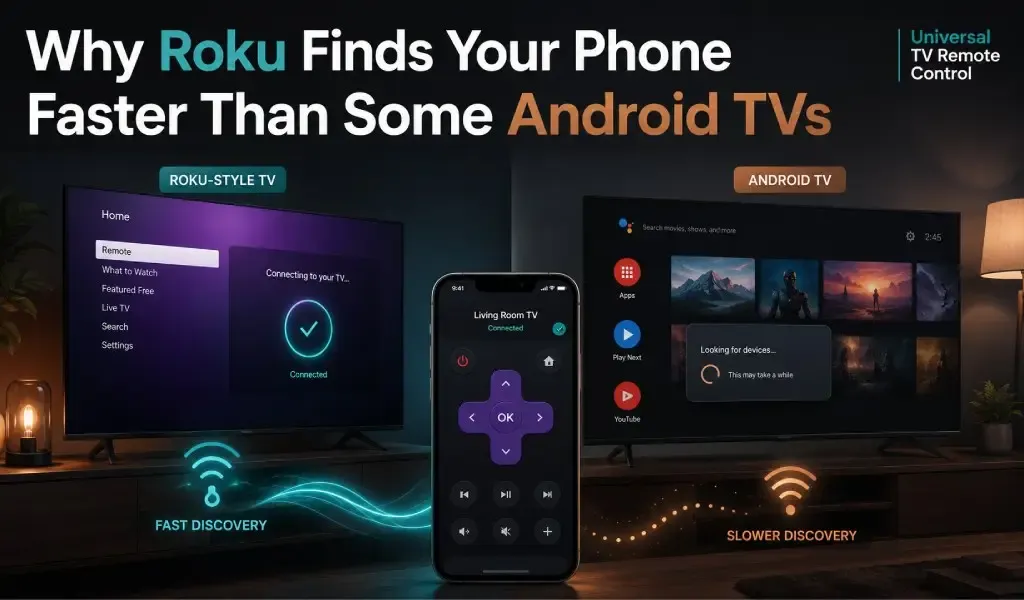
Roku often finds your phone faster because it uses a simpler and more consistent device discovery process than many Android TVs.
If you've ever opened a TV remote app and noticed your Roku TV appears almost instantly while an Android TV takes several seconds or doesn't appear at all, you're not imagining it.
Many users assume the problem is their phone or WiFi speed. In reality, the difference usually comes down to how each platform discovers devices, responds to network requests, and manages background services.
Roku is built around a tightly controlled operating system with consistent networking behaviour across nearly every device. Android TV, on the other hand, is used by many manufacturers, each adding their own software, settings, and customisations.
This guide explains why Roku often connects faster, why Android TVs sometimes take longer to appear, and what you can do to improve your experience regardless of which television you own.
How Does a TV Remote App Find Your Television?
A TV remote app finds your television by searching your local network for compatible devices.
When you open a remote app, it immediately begins looking for televisions connected to the same WiFi network.
Instead of using the internet, your phone communicates only within your home network.
The discovery process usually involves:
- Broadcasting discovery requests
- Listening for TV responses
- Verifying compatible devices
- Establishing a secure local connection
This entire process often takes only a few seconds when everything is working correctly.
Read Also: Google TV vs Android TV: Do Remote Apps Work Differently on Each?
Why Does Roku Usually Appear Faster?
Roku appears faster because every Roku device follows nearly identical discovery rules.
One of Roku's biggest advantages is consistency.
Whether you own an older Roku Express or a newer Roku TV, the operating system behaves very similarly.
That consistency allows remote apps to know exactly how Roku devices respond.
Benefits include:
- Consistent network responses
- Predictable discovery behaviour
- Minimal manufacturer modifications
- Optimised communication between the phone and TV
Because there are fewer variables, Roku devices are usually discovered very quickly.
Why Can Android TVs Take Longer?
Android TVs can take longer because different manufacturers customise the operating system in different ways.
Unlike Roku, Android TV is not built by a single television manufacturer.
Brands such as Sony, TCL, Philips, Hisense, Sharp, Xiaomi, and others often modify Android TV to suit their own hardware and software.
These changes may affect:
- Network discovery timing
- Power management
- Background services
- System permissions
- Wireless communication
As a result, two Android TVs running similar software may respond differently even when connected to the same network.
Does Device Discovery Work the Same on Every TV?
No, every television platform uses its own discovery methods and connection priorities.
Although many smart TVs support common networking standards, manufacturers often implement them differently.
Some televisions respond immediately.
Others wait until certain services are active.
Some reduce network activity while idle to save power.
Others continue responding even while the screen appears to be off.
These small differences can noticeably affect how quickly your phone discovers the television.
Does Sleep Mode Affect Discovery?
Yes, sleep mode can delay how quickly your television responds to your phone.
Many smart TVs reduce background activity when entering standby mode.
Depending on the manufacturer, the television may:
- Slow network communication
- Pause discovery services
- Disable certain wireless functions
- Wait until partially waking before responding
Roku devices generally maintain reliable network visibility during standby, while some Android TVs become less responsive until they fully wake.
Can Router Settings Make Roku Feel Faster?
Yes, your router configuration can influence how quickly any television is discovered.
Even if your TV is working correctly, poor network settings may delay communication.
Common causes include:
Guest Networks
Guest networks often prevent devices from communicating with each other.
Your phone and television should both connect to your primary home network.
AP Isolation
AP Isolation blocks local communication between connected devices.
When enabled, your phone may never detect your television even though both are connected to the same router.
Weak WiFi Coverage
Weak wireless signals increase communication delays.
If your television is located far from the router, discovery requests may take longer or occasionally fail.
Network Congestion
Heavy network traffic can slow device discovery.
Streaming video, online gaming, cloud backups, and multiple smart home devices all compete for wireless resources.
Modern routers manage congestion more efficiently, improving overall responsiveness.
Does Internet Speed Matter?
No, internet speed has very little effect on how quickly your phone discovers your TV.
Device discovery happens inside your local network.
Whether your broadband speed is 20 Mbps or 1 Gbps, your phone still communicates directly with the television.
Instead, these factors matter more:
- Stable WiFi coverage
- Reliable router performance
- Strong signal strength
- Correct network configuration
Why Does Roku Feel More Reliable?
Roku feels more reliable because its software ecosystem is smaller and more consistent.
Roku controls both the operating system and the user experience across supported devices.
That allows software updates to remain predictable.
Android TV must support:
- Different television manufacturers
- Various processors
- Different wireless hardware
- Multiple software customisations
Supporting a wider hardware ecosystem naturally introduces more variation.
That does not mean Android TV performs poorly.
It simply means discovery behaviour is less uniform across brands.
How Can You Make Android TV Respond Faster?
A few simple changes often improve Android TV discovery and response times.
Try these recommendations:
- Connect your phone and TV to the same WiFi network.
- Avoid using guest WiFi.
- Restart your router occasionally.
- Keep your TV software updated.
- Enable required phone permissions.
- Place the router closer to the television if possible.
- Avoid unnecessary wireless interference.
- Restart the television if discovery becomes inconsistent.
These steps solve many common connection problems without replacing your equipment.
Read Also: TCL TV Navigation Is Slow? Speed It Up with Smarter Control Methods
What Role Does a TV Remote App Play?
A well designed TV remote app helps establish reliable communication once your television becomes discoverable.
A remote app cannot force a television to respond faster than its operating system allows.
However, a quality app can:
- Detect compatible televisions efficiently.
- Maintain stable communication.
- Reconnect quickly after temporary interruptions.
- Provide responsive controls once connected.
Universal TV Remote Control has been downloaded more than 130 million times, is available in 100+ countries, and supports over 700 TV brands.
Its features include:
- Smooth D Pad navigation
- Voice control
- Built in keyboard support
- User friendly interface
- Strong customer support
When combined with a properly configured home network, these features help deliver a reliable remote control experience across a wide variety of smart televisions.
Final Verdict
Roku usually finds your phone faster because its networking behaviour is more consistent, not because it has faster hardware.
The difference between Roku and Android TV is rarely caused by internet speed.
Instead, it comes from operating system design, device discovery behaviour, manufacturer customisations, power management, and home network configuration.
If your Android TV occasionally takes longer to appear, it does not necessarily indicate a fault.
Keeping your television updated, using a stable WiFi network, and ensuring both devices share the same local network will usually provide the best experience.
Regardless of which smart TV you own, a reliable home network and a compatible remote app remain the foundation of fast and consistent device discovery.
Frequently Asked Questions
Can two Roku devices appear at the same time in a remote app?
Yes. If both Roku devices are connected to the same WiFi network, most compatible remote apps can display each device separately, allowing you to choose the one you want to control.
Why does my TV appear with a different name than expected?
Many televisions display the device name assigned during setup or the name configured in the TV's network settings. You can often rename the TV from its settings menu to make it easier to identify.
Does restarting my phone help with TV discovery?
Yes. Restarting your phone refreshes network services and wireless connections, which can sometimes resolve temporary discovery issues without changing any TV settings.
Can multiple phones control the same smart TV?
Yes. Most modern smart TVs allow multiple phones to connect as remote controls, provided they are on the same local network and the TV supports simultaneous connections.
Why does my TV appear immediately one day but slowly the next?
Background software updates, temporary network congestion, router restarts, or the TV entering different standby states can all affect discovery time from one session to another.
Is changing my WiFi channel useful for TV remote apps?
In some homes, yes. If nearby networks are causing wireless interference, selecting a less congested WiFi channel can improve local communication and make device discovery more consistent.