
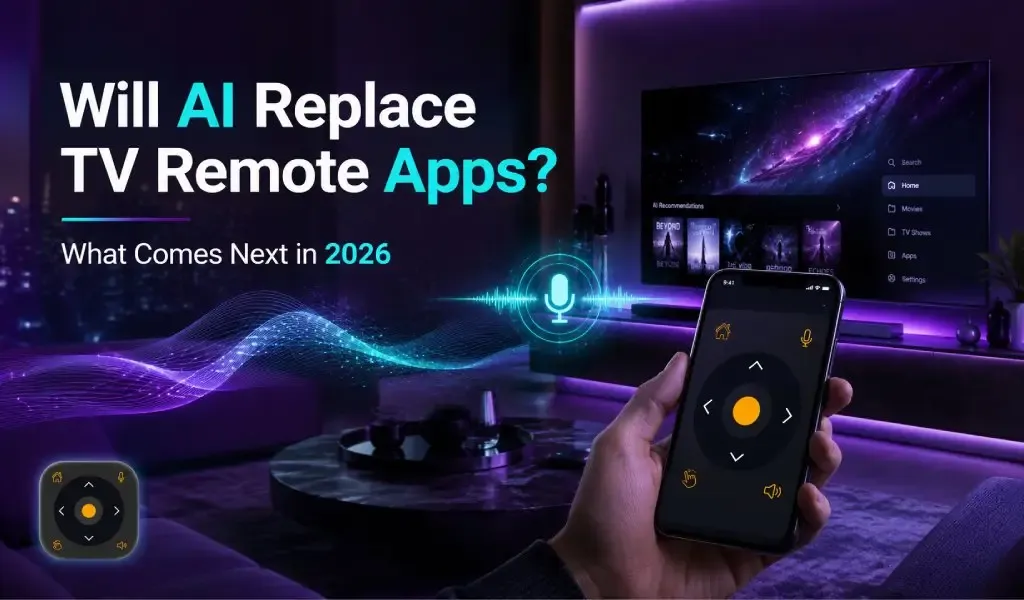
AI is unlikely to replace TV remote apps completely because controlling a TV still requires reliable input, device compatibility, and a direct connection.
AI is changing how people interact with televisions. Google TV now uses Gemini for conversational searches, recommendations, and some TV settings. Samsung is also pushing conversational control through Vision AI Companion on newer TVs.
That sounds like the end of the traditional remote. It is not.
AI can understand what you want. It does not automatically solve every problem involved in sending that command to a television. Someone still needs to navigate menus, adjust volume, enter text, switch inputs, open apps, and control TVs that may use very different systems.
This is where remote apps still have an important role.
The future is less about AI versus remote apps and more about AI working with remote control technology.
What Is Actually Changing About TV Control?
TV control is moving from button based commands toward natural language, automation, and context aware interaction.
For years, controlling a TV meant pressing individual buttons. Want to increase the volume? Press volume up. Want to find a movie? Open an app and type the title one letter at a time.
That model is changing.
Google's Gemini for TV can understand conversational requests and help users find shows, ask questions, and perform certain actions. Google has also introduced voice based controls for picture and sound settings on selected TVs.
Samsung is taking a similar direction. Its Vision AI Companion allows users to interact with compatible TVs through more natural conversations and access information and recommendations.
The important point is that these systems are still tied to specific TV platforms and supported devices. They are not universal replacements for every remote.
Why AI Alone Cannot Replace a TV Remote
AI can understand a command, but a remote control system still has to deliver that command to the correct TV.
Consider a simple request such as, “Turn the volume down.”
An AI assistant may understand the sentence instantly. But several things still need to happen behind the scenes. The system must identify the correct television, establish communication, confirm that the device accepts the command, and then send it.
The same problem becomes more obvious in homes with multiple TVs.
If you have a Samsung TV in the bedroom and an LG TV in the living room, an AI assistant needs to know which device you mean. Network discovery, permissions, device pairing, and platform support still matter.
This is why remote control technology will remain important even as AI becomes smarter.
Where AI Is Better Than Traditional Remote Controls
AI is better at understanding intent because users can describe what they want instead of remembering exact button commands.
Imagine saying:
“Find a funny action movie for tonight.”
That is very different from pressing Home, opening a streaming service, navigating menus, and typing a search query.
Google is already moving in this direction with Gemini for TV. Its conversational features can help users discover content based on natural language rather than exact titles.
AI can also help with more complex requests. Google says Gemini can help users adjust picture and sound settings through natural language on supported devices.
This is a major shift.
The remote is no longer just a collection of buttons. It can become a way to communicate what you want the TV to do.
Why Physical and Mobile Remote Controls Still Matter
Traditional remote controls remain useful because direct buttons are often faster for simple actions.
If you want to lower the volume by two steps, saying a voice command may take longer than pressing a button.
The same applies to navigation. Moving through a streaming menu can be easier with a directional pad than explaining each action to an assistant.
Typing is another example. Voice search is useful, but there are situations where entering text from a phone is more convenient.
This is one reason mobile remote apps remain relevant.
How Universal TV Remote Control Fits Into This Future
Universal TV Remote Control can complement the shift toward smarter TV interaction by combining direct controls with voice, keyboard, and broad TV compatibility.
Universal TV Remote Control is designed around the practical side of TV control.
The app supports more than 700 TV brands and is available in 100+ countries, giving it a much broader role than a remote designed for one TV ecosystem. The service also reports more than 130 million downloads.
Its features cover several areas that AI does not replace.
The D Pad gives users direct navigation. The keyboard makes TV searches faster than entering letters one at a time with a physical remote. Voice control adds a more natural way to search and interact.
That combination matters because users do not always want the same type of control.
Sometimes a voice command is easiest. Sometimes a directional button is faster. Sometimes typing on a phone is the better option.
A good remote experience should support all three.
Could AI Make Universal Remote Apps More Useful?
AI could make universal remote apps more useful by adding smarter commands on top of existing controls.
This is where the future becomes interesting.
Instead of replacing the remote interface, AI could become an additional layer.
You might tell the app, “Open YouTube and search for relaxing music.”
The app could understand the request and then use its existing controls to perform the actions.
Another example could be:
“Make the volume lower and open Netflix.”
The AI understands the intention. The remote technology handles the actual interaction.
This approach combines two strengths. AI handles language and intent. Remote technology handles device communication.
Why Universal Compatibility Will Become More Important
Universal compatibility will matter more as homes continue to contain TVs from different brands and platforms.
Smart TV software is not becoming more uniform. Google TV, Android TV, Samsung's Tizen based environment, Roku, Fire TV, LG webOS, and other platforms each have their own systems.
Even within one brand, models can use different operating systems or connection methods.
Universal TV Remote Control already focuses on this problem by supporting more than 700 TV brands. Its supported brand list includes Samsung, LG, Sony, TCL, Roku, Hisense, Philips, Toshiba, Vizio, and others.
That broad compatibility becomes even more useful as AI features remain unevenly distributed.
A new AI feature may be available on one TV but not another. A universal remote app can still provide core control across a much wider range of devices.
Will AI Make D Pad Navigation Obsolete?
AI will not make D Pad navigation obsolete because direct navigation remains useful for precise and predictable control.
A D Pad is simple.
Press up. Move up.
Press down. Move down.
Press left. Move left.
Press OK. Select the item.
There is no interpretation involved.
This matters when browsing menus, changing settings, or moving through streaming interfaces. The Universal TV Remote Control app includes D Pad navigation for exactly this type of control.
AI can reduce the number of steps needed for some tasks. It does not remove the need for precise manual input.
The two approaches can work together rather than compete.
Will Voice Control Become the Main Way to Control TVs?
Voice control will become more important, but it is unlikely to become the only way people control televisions.
Voice is excellent when you know what you want.
“Open Netflix.”
“Find action movies.”
“Turn the volume down.”
“Show me sports.”
These requests are easy to express naturally.
But voice is not always practical. You may be in a noisy room. Other people may be sleeping. You may not want to speak out loud. Or you may simply prefer pressing a button.
That is why voice should be treated as another control method rather than the replacement for every other method.
Universal TV Remote Control already includes voice control alongside its D Pad and keyboard features, giving users multiple ways to interact with their TV.
What About AI TV Control Without a Phone?
AI controlled TVs will increasingly perform some tasks directly through built in microphones and smart TV systems.
This is already happening.
Google says compatible Google TV devices can support hands free Gemini interaction, while Samsung's Vision AI Companion uses compatible TV hardware and remotes for conversational interaction.
That could reduce the need to reach for a phone for simple requests.
However, it does not eliminate the need for remote technology.
Built in AI depends on the TV supporting the feature. Availability can also vary by model, country, language, age, and software version. Google's current Gemini for TV availability is limited to selected devices and regions, with wider expansion planned later in 2026.
Universal apps can remain useful because they offer another control route when built in features are unavailable or inconvenient.
What Will the TV Remote App of the Future Look Like?
The TV remote app of the future will likely combine traditional controls, voice commands, AI assistance, and broader device awareness.
The basic remote interface will probably remain.
A D Pad will still make sense. Volume buttons will still make sense. A keyboard will still be useful.
What changes is the layer above those controls.
Instead of navigating every menu manually, users may ask the app to complete simple tasks. The app could understand the request, identify the correct TV, and use the appropriate control method.
The result would feel less like using a remote and more like telling the TV what you want.
That is a much more realistic future than the idea of AI simply deleting remote apps.
What Should Users Expect From TV Remote Apps Next?
Users should expect remote apps to become more intelligent without losing the direct controls that make them reliable.
The next stage will likely focus on three areas.
First, better voice understanding. Users will not need to memorize exact commands.
Second, smarter device detection. Apps will need to identify TVs more quickly and handle homes with multiple devices.
Third, combined control. Voice, keyboard, D Pad, touch controls, and AI assistance will work together instead of existing as separate features.
This direction fits the way smart TVs are evolving. Google is already expanding Gemini beyond content discovery into settings, visual answers, and interactive experiences.
Frequently Asked Questions
Will AI completely replace physical TV remotes?
No. AI may reduce the need for some remote actions, but physical buttons remain useful for fast and precise control.
Can AI control any smart TV?
No. AI TV features depend on the TV model, operating system, software, region, and supported services.
Are TV remote apps becoming outdated?
No. Remote apps are evolving by adding features such as voice control, keyboard input, smarter discovery, and broader compatibility.
Can I use AI and a TV remote app together?
Yes. AI can handle natural language requests while a remote app provides direct navigation and device control.
Will voice control replace the keyboard in TV remote apps?
Not completely. Voice is convenient for searches, while a phone keyboard can be better when entering names, passwords, or longer text.
Why would I need a universal remote app if my TV has AI?
A universal app can provide an alternative control method and support a wider range of TV brands and models than one built in TV assistant.
Does Universal TV Remote Control support voice control?
Yes. Universal TV Remote Control includes voice control along with D Pad navigation and keyboard input.
How many TV brands does Universal TV Remote Control support?
The app supports more than 700 TV brands, including major platforms such as Samsung, LG, Sony, Roku, TCL, Hisense, Philips, and others.
Where can I get Universal TV Remote Control?
The app is available for both Android and iPhone.
Download Universal TV Remote Control for Android
Download Universal TV Remote Control for iPhone
The Future Is Not AI Instead of Remote Apps
The more likely future is AI working alongside remote control apps to make TV interaction faster and more natural.
AI is already changing television interaction. Google and Samsung are moving toward conversational control, smarter recommendations, and voice based settings.
But the remote itself is not disappearing.
People still need reliable navigation. They still need volume controls. They still need a way to type. They still need compatibility across different TVs.
That is where universal remote apps can continue to matter.
The future TV remote may not look like the remote we use today. It may understand natural language, remember preferences, identify devices, and automate several actions at once.
But underneath that intelligence, there will still be a simple requirement:
The TV needs a reliable way to receive and execute the command.
That is why AI is more likely to transform TV remote apps than replace them.